

Nvidia GeForce RTX 2070 Founders Edition review: Better tomorrow and today - harbuckfingir
At a Glance
Expert's Rating
Pros
- Great 1440p and entry-level 4K gaming performance
- Founders Variation is beautifully designed
- Easily overclocked
- RT and tensor cores for ray trace, DLSS, and more
Cons
- Ray trace and DLSS not available in games yet
- Non a huge performance leap over GTX 1080
- Expensive
Our Verdict
The Nvidia GeForce RTX 2070 Founders Variant packs artistic movement computer hardware for ray tracing and AI-enhanced nontextual matter, but IT's also faster than the competitor in traditional games. Nvidia's design is gorgeous, but similar performance can embody achieved with lower-priced RTX 2070 graphics card game.
Best Prices Now

$599.99
Nvidia's GeForce RTX 2070 is a art card built for the future, just equivalent the GeForce RTX 2080 and 2080 Ti. And just like its siblings, the RTX 2070's artistic movement hardware comes at a stiff Mary Leontyne Pric premium.
At a $500 starting price and $600 for the Nvidia Founders Edition being reviewed here, the inclusion of dedicated RTX hardware bumps the price of Nvidia's traditionally midrange xx70 GPUs prepared by well terminated $100, planting it in the range of the existing GTX 1080. But unlike with the RTX 2080, Nvidia isn't interrogative you to enthrone entirely in as-notwithstandin-unfulfilled promises for the future. The GeForce RTX 2070 delivers an appreciable bump over the GTX 1080's execution in today's games, likewise.
You can still find the experienced art tease on sale all over the set out, though, and often at a ignore. Should you buy a shiny new RTX graphics card, with its untapped potential for real-sentence ray tracing and AI-increased games, concluded a cheaper GTX 1080? Let's review the Nvidia GeForce RTX 2070 Founders Variation ($600 at Best Buy and GeForce.com).
Nvidia GeForce RTX 2070 Founders Edition: Spectacles, features, and design
Nvidia added dedicated RT cores for real-prison term radiate trace and dedicated tensor cores for AI enhancements in the RTX serial publication, but that wasn't the solitary hardware pull off. The GTX 10-series incarnation cragfast to reference speeds and a cetacean mammal-style cooler that was prone to energy throttling. This generation, Nvidia panoplied its Founders Edition card game with a soft overclock and an improved three-fold-fan cooling solution to service justify its price superior.
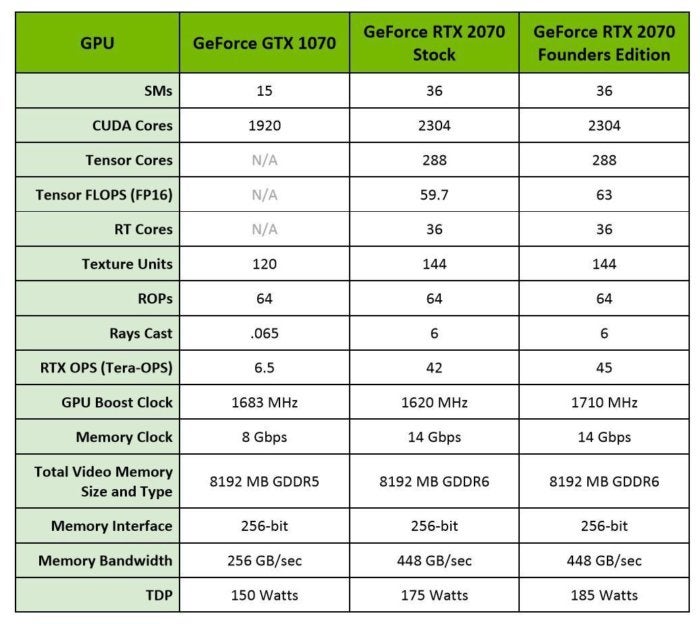
That means Founders Edition specs differ slightly from RTX 2070 reference specs. Here's how the reference and Founders Variation RTX 2070 stack up under the hood compared to the older $380 GTX 1070 (though once more, at its higher price point, the $500 RTX 2070 more directly compares to the $500 GTX 1080).
 Nvidia
 Nvidia GeForce RTX 2070 and 2070 Founders Edition spectacles vs. GTX 1070.
As you can see, the RTX 2070 Founders Edition has much CUDA cores and texture units than its predecessor, as fit as a slightly higher cost increase clock speed and much faster GDDR6 retentivity. Spoiler wary: The RTX 2070 is a lot faster than the GTX 1070 in traditional games, and even a little ahead of the GTX 1080.
It'll be quicker in tomorrow's games, too, As the RTX 2070 includes those dedicated RT and tensor cores to drastically heighten period electron beam tracing execution and unlock the ability to bring machine learning enhancements to games, such as Deep Learning Super Sampling. Unfortunately, no current games tap into either technology, though dozens of games have pledged RTX reinforcement.
The want of available irradiate-traced or DLSS games is a bummer with this graphics card in particular. The RTX 2070 packs incomplete as many RT and tensor cores as the full-fat GeForce RTX 2080 Ti, and we have no way of testing how much that will impact performance—so you're fetching a leap of faith that not solely will those technologies catch on, but the RTX 2070 will make up able to handle them well. Fingers crossed.
 Brad Chacos/IDG
 While we await for the first ray traced and DLSS games to bring up, you can read more about the technologies in our deep-dive into the Nvidia Turing GPU equally well as the prox tech incision of our RTX 2080 and 2080 Ti reappraisal, where we examined some canned demos provided by Nvidia.
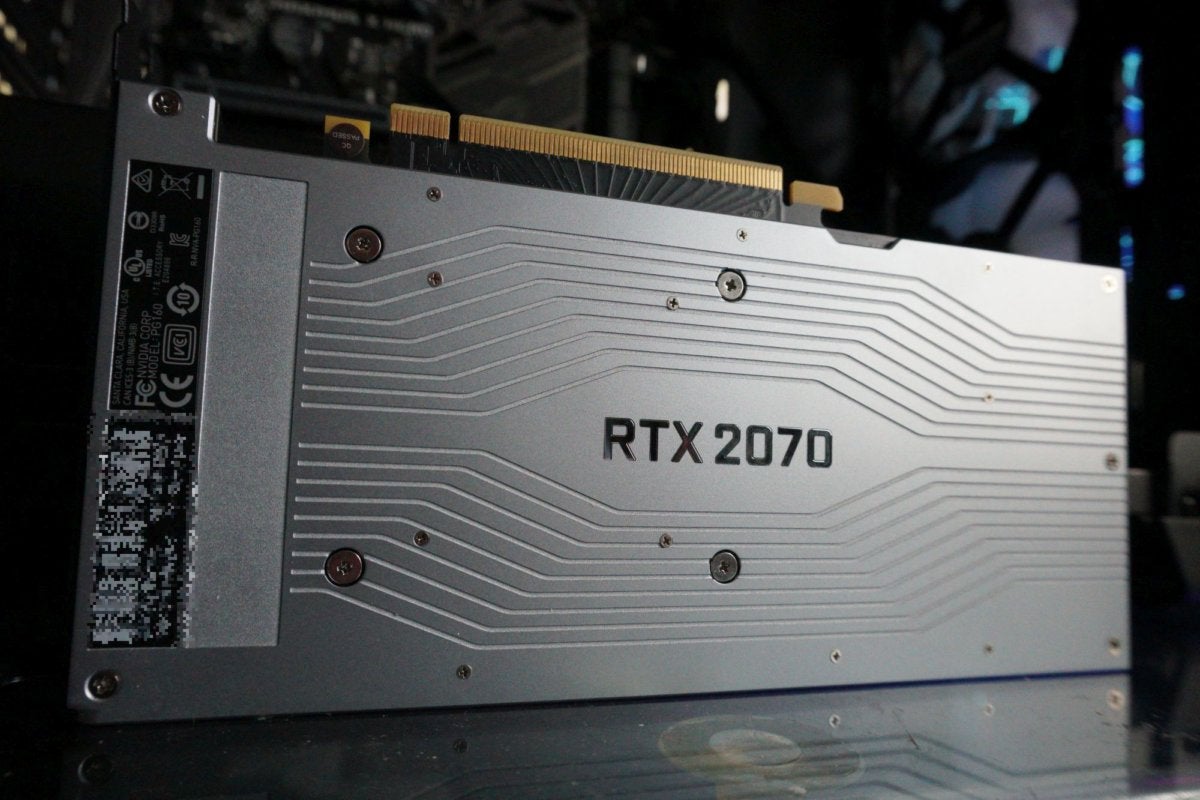
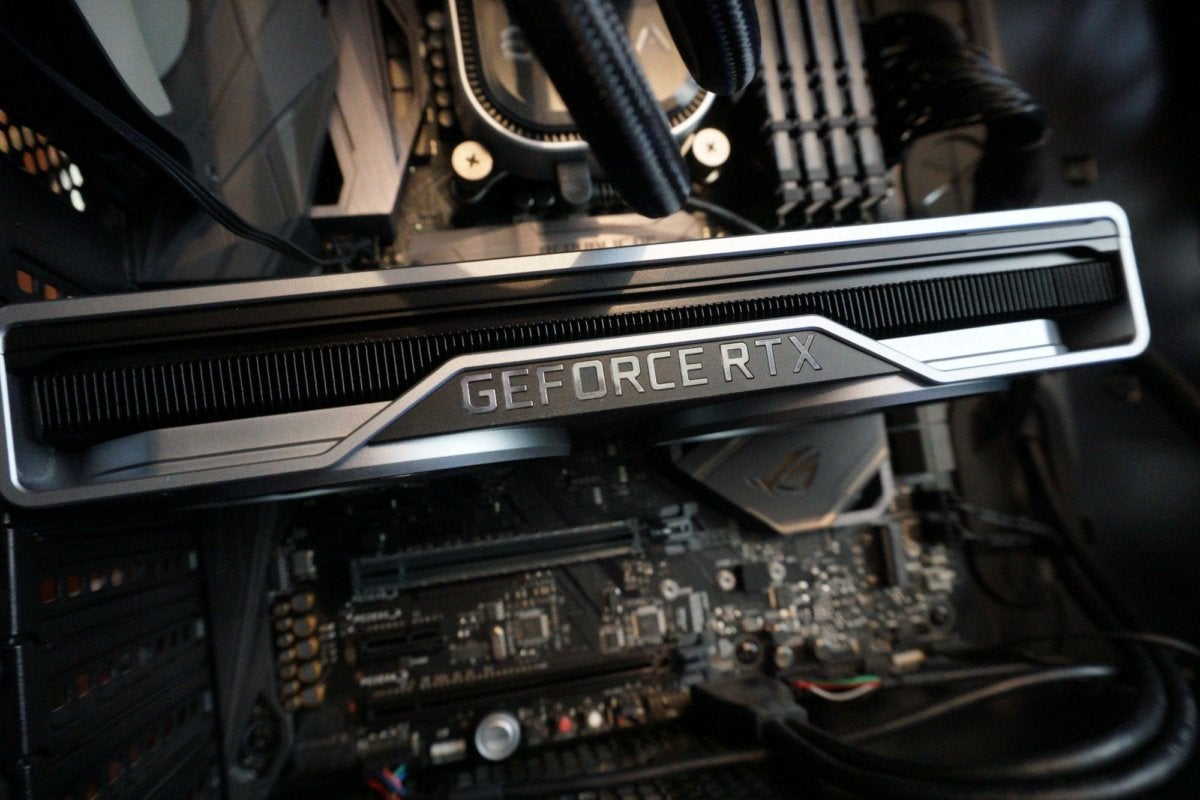
Each that extra hardware demands more superpowe, with the reference RTX 2070 requiring 25 more Isaac Watts than its predecessor, and the Founders Version exacting 10 more that, at 185W. Nvidia recommends using a 550W power provision. That power flows to the Founders Edition via a lonesome eight-personal identification number connector at the very end of batting order, rather than the usual edge placement. I ordinarily loathe that form, but it works here, mostly because the Nvidia RTX 2070 Founders Edition is so flyspeck. The two-slot tease measures a mere nine inches in length, or 1.5 inches shorter than typical graphics cards, so hanging the power connection off the backmost ISN't an issue.
 Brad Chacos/IDG
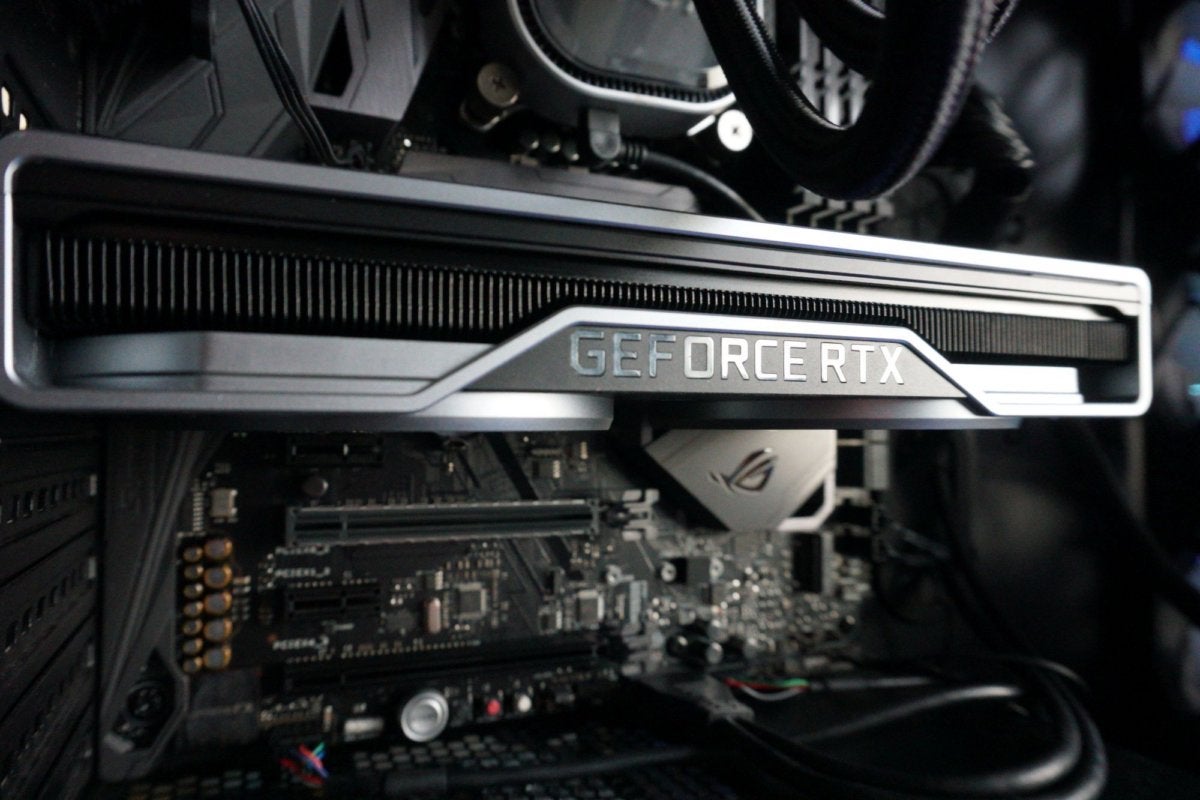
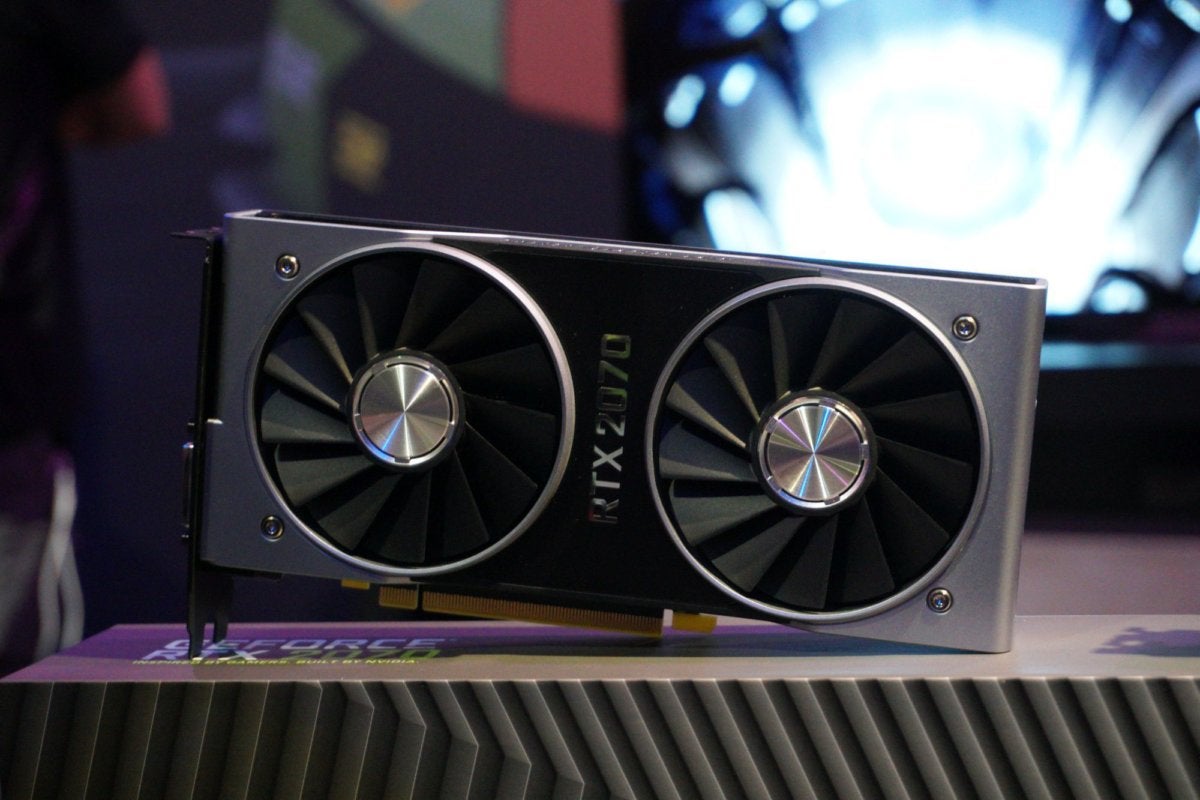
 Other than the size, the RTX 2070 sticks to Nvidia's incredibly successful Founders Version redesign. It's an absolutely gorgeous graphics card, with a counterfeit aluminum shroud that wraps around into a backplate. Its dual fans bristle with 13 blades each, and you can see the black heat sink peeking through the margin, sitting atop a uncut vapour chamber. You'll find double DisplayPort 1.4 connections, an HDMI 2.0b porthole, DVI-D, and a VirtualLink USB-C connection for VR headsets on the I/O plate. You won't come up an SLI/NVLink connector happening the card, though—the RTX 2070 ISN't intended for use in multi-card systems.
Nvidia's RTX 2070 feels voluptuous and substantial. I love it. Deterrent out the Founders Variant design section of our RTX 2080 and 2080 Ti review if you want deeper details. We're moving onto benchmarks.
Next page: Our test system, benchmarks start out
Our test organisation
Our dedicated graphics card test system is configured with some of the quickest complemental components available, to put any potential performance bottlenecks squarely on the GPU. Most of the hardware was provided away the manufacturers, but we purchased the ice chest and computer storage ourselves.
- Intel Core i7-8700K processor ($360 on Amazon)
- EVGA CLC 240 closed-closed circuit liquid cooler ($120 on Amazon River)
- Asus Maximus X Hero motherboard ($260 on Amazon)
- 64GB HyperX Predator RGB DDR4/2933 ($416 for 32GB on Amazon)
- EVGA 1200W SuperNova P2 power supply ($180 on Amazon)
- Corsair Crystal 570X RGB case, with front and top panels separate and an extra rear sports fan installed for improved airflow ($170 on Amazon)
- 2x 500GB Samsung 860 EVO SSDs ($100 on Amazon)
We're comparing Nvidia GeForce RTX 2070 Founders Edition ($600 at Best Buy up and GeForce.com) against EVGA's custom RTX 2070 XC ($550), and the GeForce RTX 2080 Founders Edition ($799 at Best Buy surgery GeForce.com) and RTX 2080 Si Founders Edition ($1,199 at Best Buy and GeForce.com). We've also tested its performance compared to the GeForce GTX 1070 Founders Variation, GeForce GTX 1080 Founders Variation, and PNY GeForce GTX 1080 Titanium. Finally, we've included results from the Radeon RX Vega 64 reference card, AMD's almost potent GPU. It generally competes with the GTX 1080.
Each game is tested using its in-game benchmark at the highest assertable graphics presets, with VSync, skeleton rate caps, and all GPU vendor-particular technologies—like-minded AMD TressFX, Nvidia GameWorks options, and FreeSync/G-Synchronize—disabled, and worldly anti-aliasing (TAA) enabled to push these high-end cards to their limits. If anything differs from that, we'll mention it.
We tried and true these cards at 4K, 1440p, and 1080p resolutions. We redact most of our focus on comparing the RTX 2070 Founders Variation against the GTX 1080 and Vega 64, as they're all more or less $500. The GTX 1070 debuted at $380.
Nvidia GeForce RTX 2070 Founders Edition performance benchmarks
Strange Brigade
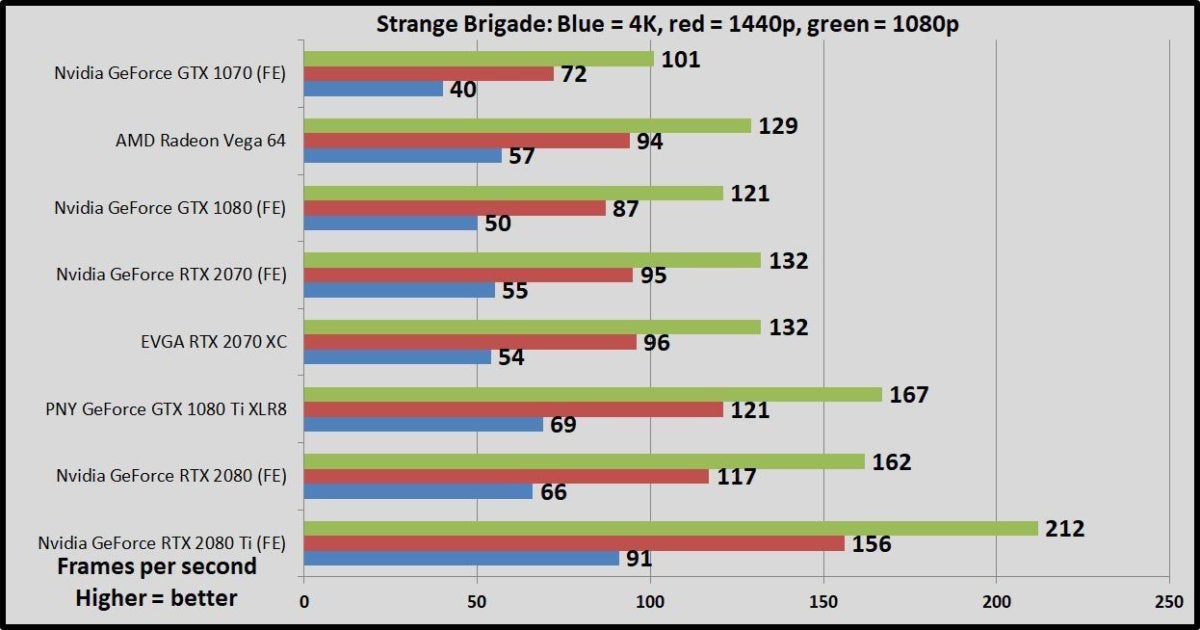
Army of the Righteou's kick out things off with Fantastical Brigade ($50 connected Abase), a cooperative third-person shooter where a team of adventurers blast through hordes of unreal enemies. It's a discipline showcase, built just about the next-gen Vulkan and DirectX 12 technologies and infused with features like HDR support and the power to toggle asynchronous compute off and on. IT uses Rebellion's made-to-order Azure railway locomotive. We test with async compute soured.
 Brad Chacos/IDG
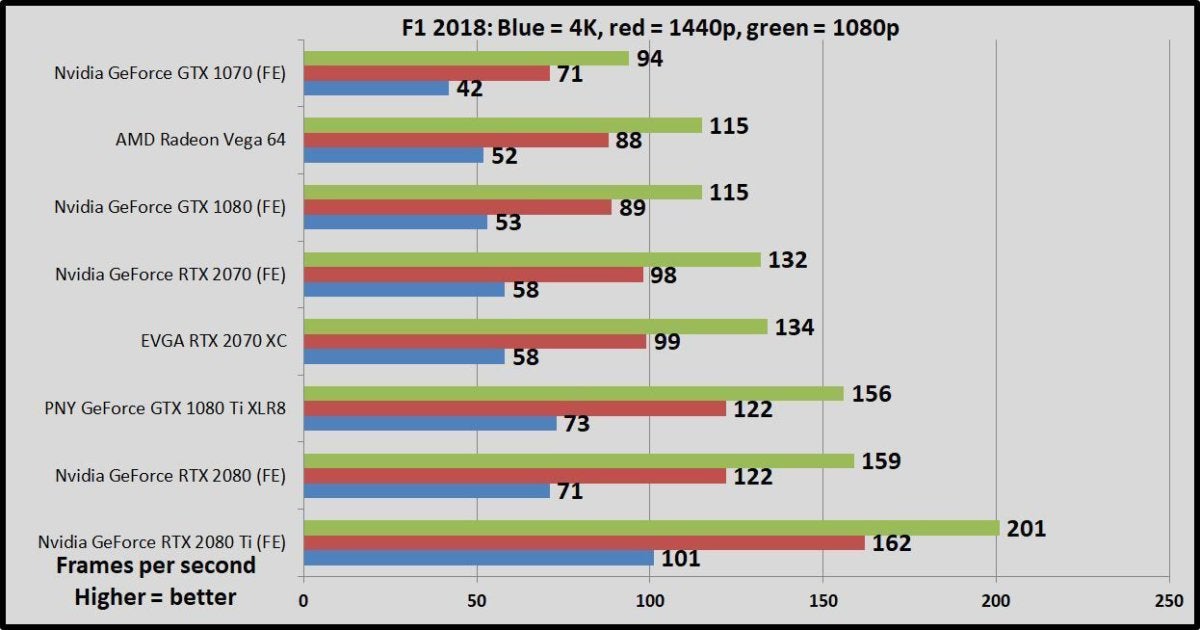
 The RTX 2070 Founders Variation is 9.2 percent quicker than the GTX 1080 Founders Edition at 1440p resolution, and or s the same fastness as the Vega 64. That's a trend we'll go forward to see. The 2070 FE is faster than the GTX 1080 aside 9 to 13 percent in near games, though that expands to 20-plus percent in a couple of titles, and just 3 percent in another. We'll foreground those oddities as we encounter them.
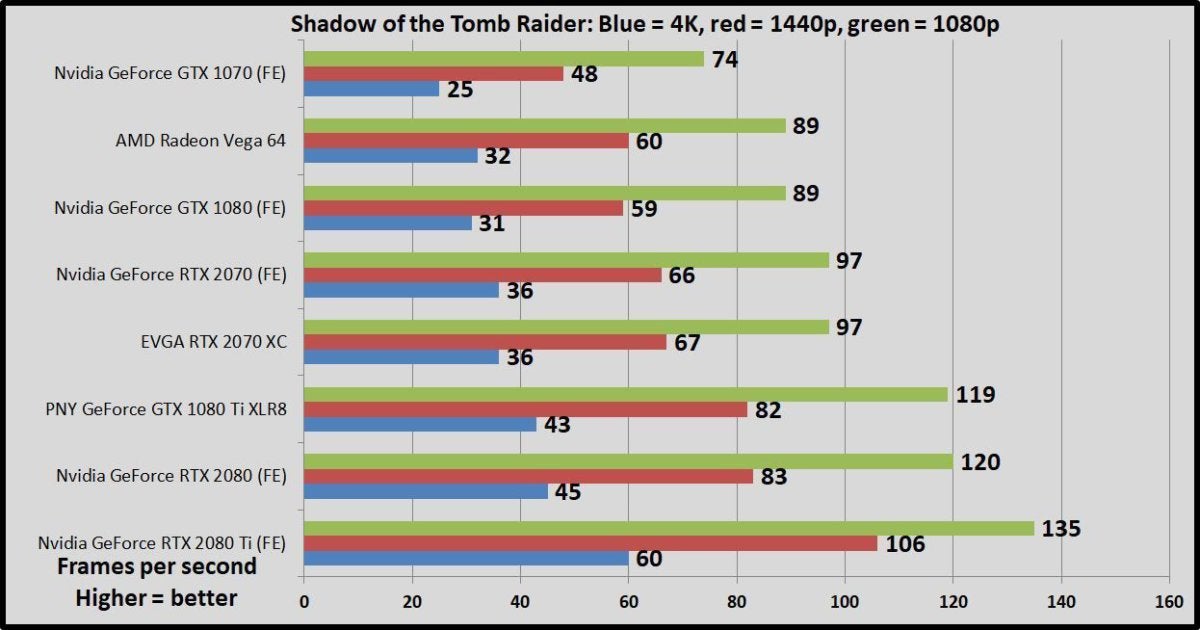
Shadow of the Grave Raider
Phantom of the Tomb Plunderer ($60 happening Humble) concludes the reboot trilogy, and it's dead gorgeous—yet the commonwealth-of-the-artwork GeForce RTX 2080 Ti barely manages to average 60 fps with entirely the bells and whistles randy at 4K resolve. Square Enix optimized this game for DX12, and recommends DX11 only if you're exploitation elderly computer hardware or Windows 7, so we test with that. Shadow of the Tomb Raider uses an enhanced version of the Foundation engine that also powered Rise of the Tomb Plunderer.
 Brad Chacos/IDG
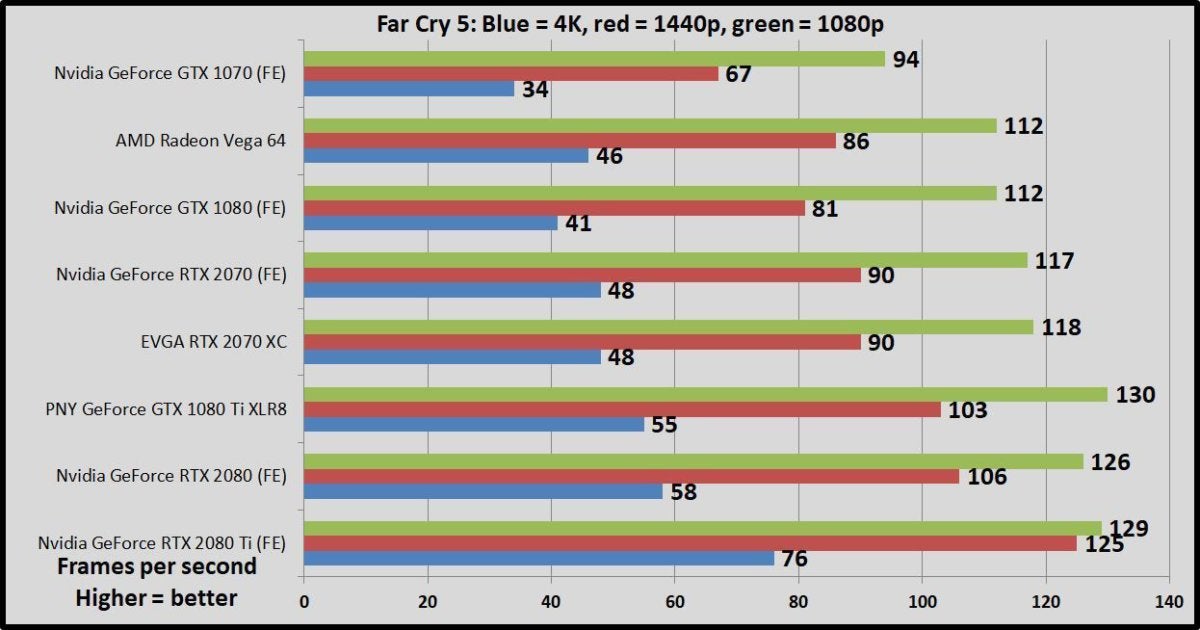
 Far Cry 5
Finally, a DirectX 11 game! Farther Cry 5 ($60 on Humble) is powered by Ubisoft's long-established Dunia engine. It's just every bit beautiful As its predecessors, and even more diverting.
 Brad Chacos/IDG
 Next page: Gritty benchmarks continue
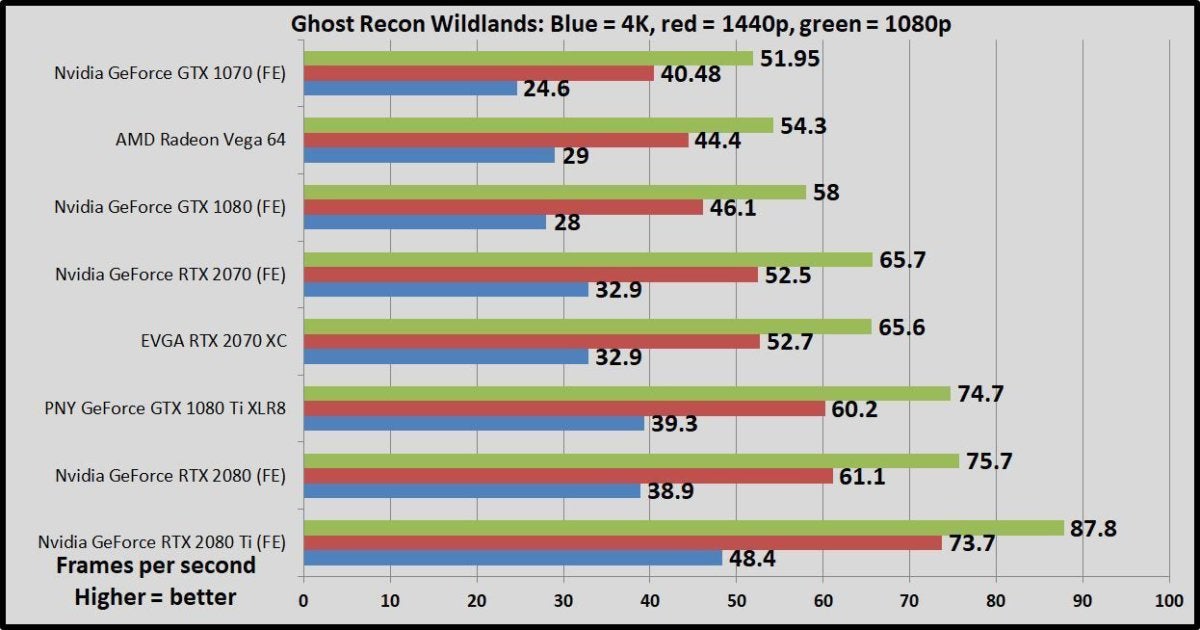
Ghost Recon Wildlands
Proceed over, Crysis. If you crank all the graphics options leading to 11, like we do for these tests, Ghost Recon Wildlands ($50 on Humble) and its AnvilNext 2.0 engine perfectly melts GPUs.
 Brad Chacos/IDG
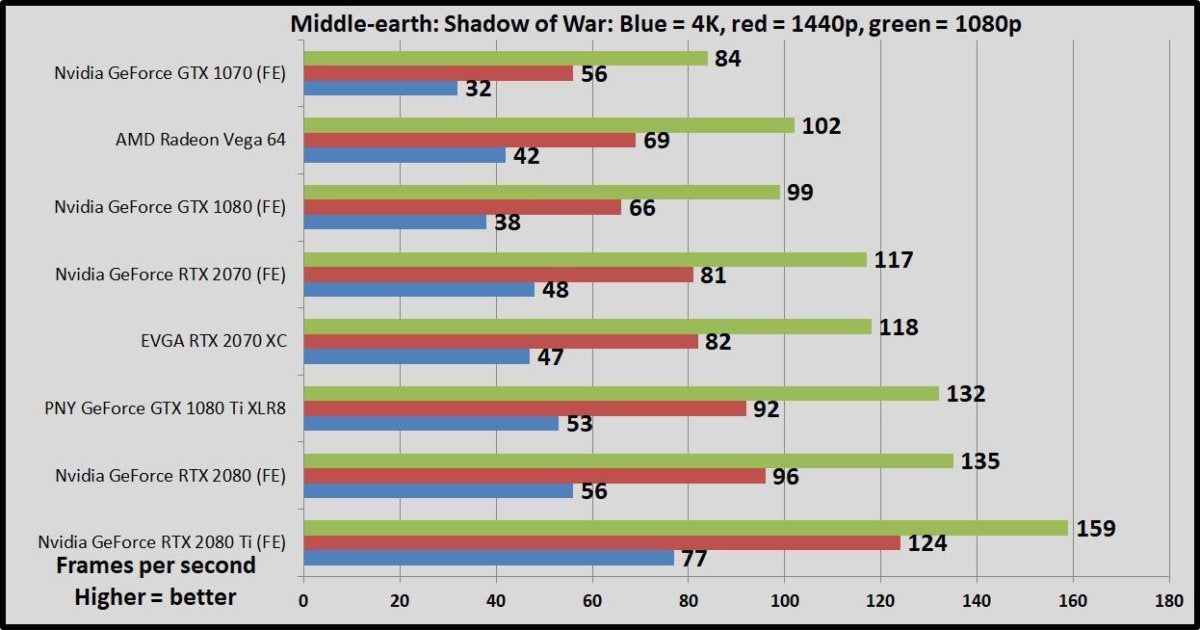
 Middle-earth: Shadow of War
Middle-earth: Shadow of War ($50 on Humble) adds a strategic stratum to the series' noble-minded core gameplay loop, adapting the Nemesis system to let you create an army of personalised Orc commanders. IT plays equivalent a champ on PC, too, thanks to Monolith's custom LithTech Icterus galbula galbul locomotive. We employ the Ultra art preset but drop the Trace Quality setting to High to avoid exceeding 8GB of VRAM usage.
 Brad Chacos/IDG
 Shadow of War responds well to nontextual matter cards with unsynchronized compute capabilities—namely Radeon GPUs and, now, the RTX 20-series. The RTX 2070 Founders Edition demolishes the Lope de Vega 64 and GTX 1080 alike present, outpacing the GTX 1080 by a healthy 23 pct. Yes, please.
F1 2018
The latest in a tenacious line of successful games, F1 2018 ($60 connected Humble) is a benchmarking gem, supply a wide array of some graphical and benchmarking options—making it a much more reliable selection that the Forza series. Information technology's built along the fourth version of Codemasters' buttery-still Ego game locomotive engine. We test two laps on the Australia course, with clear skies.
 Brad Chacos/IDG
 Next page: More game benchmarks
Ashes of the Singularity: Escalation
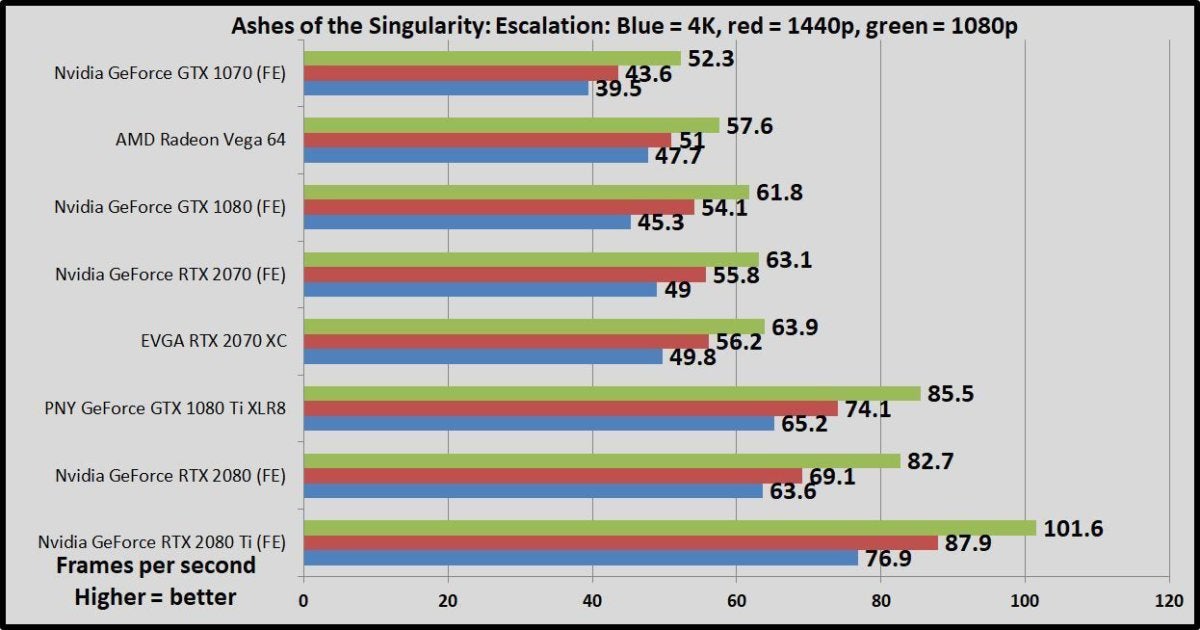
Ashes of the Singularity ($40 on Humble) was one of the selfsame first DX12 games, and it remains a flagbearer for the technology to this daytime thanks to the extreme scalability of Oxide Games' next-gen Nitrous engine. With hundreds of units onscreen simultaneously and some serious graphics effects in play, the Crazy planned can make nontextual matter cards sweat. Ashes runs in both DX11 and DX12, but we test only in DX12, as it delivers the best results for some Nvidia and AMD GPUs.
 Brad Chacos/IDG
 Here's the oddest outlier. Some AMD and Nvidia have optimized heavily for Ashes, because it's used so often in benchmarking suites, but the RTX 2070 FE sole manages to squeak past the GTX 1080 by three percent at 1440p.
GTA V
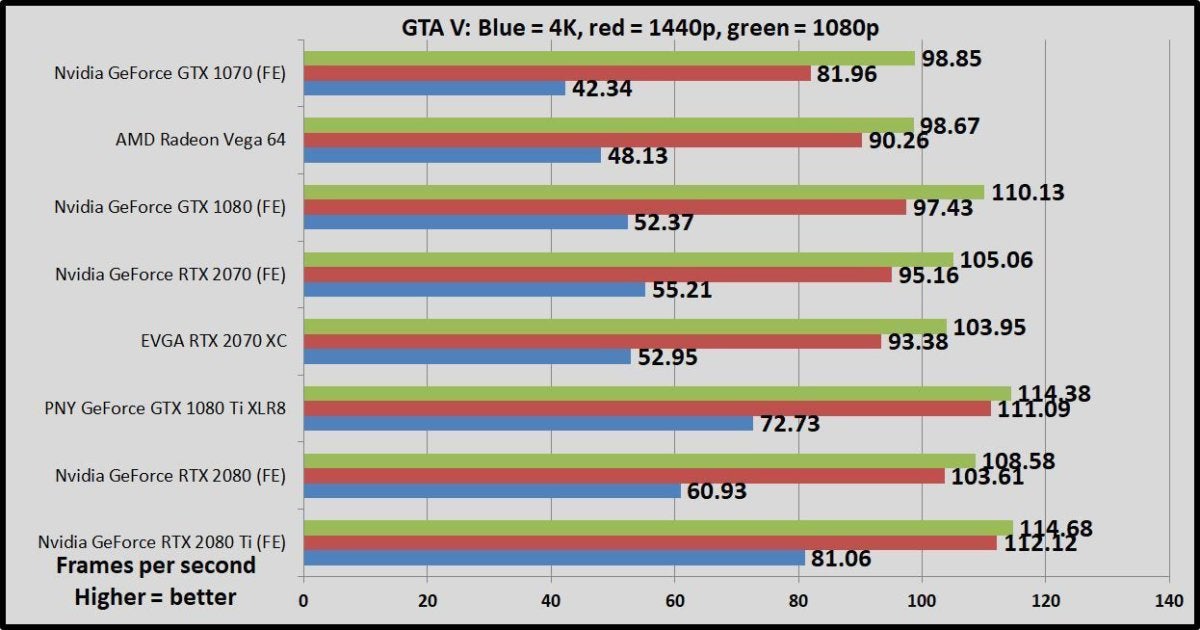
We'Re going to twine things up with a couple of older games that aren't real visual barn-burners, but still top the Steam charts Clarence Shepard Day Jr.-in and day-out. These are games that a lot of people play. 1st dormie: Grand Theft Auto V ($30 on Humble) with all options turned to Very Ill-smelling, whol Advanced Graphics options except extended shadows enabled, and FXAA. GTA V runs on the RAGE engine and has received substantial updates since its initial launch.
 Brad Chacos/IDG
 Rainbow Six Siege
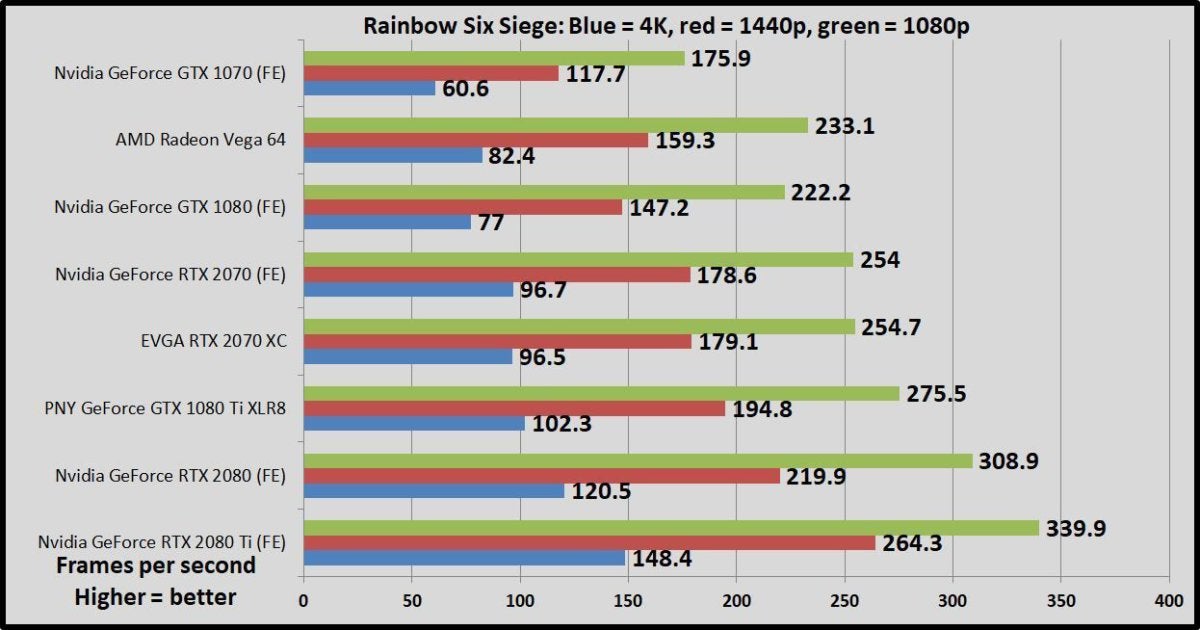
Finally, let's take a peek at Rainbow Six Siege ($40 on Humble), a plot whose audience just keeps on biological process, and one that quiet feels comparable the just truly following-gen hired gun after all these years. Like Ghost Recon Wildlands, this game runs happening Ubisoft's AnvilNext 2.0 engine, but Rainbow Six Military blockade responds especially well to games that lean on async compute features.
 Brad Chacos/IDG
 Recall how I aforementioned the RTX 20-serial publication added apodeictic async compute capabilities to Nvidia's lineup? It shows here, just like in Shadow of War. The RTX 2070 FE is faster than the GTX 1080 by 21.3 pct at 1440p resolution.
Adjacent varlet: Open fire Strike, mogul, and thermals
Fire Strike, big businessman draw, thermals, and noise
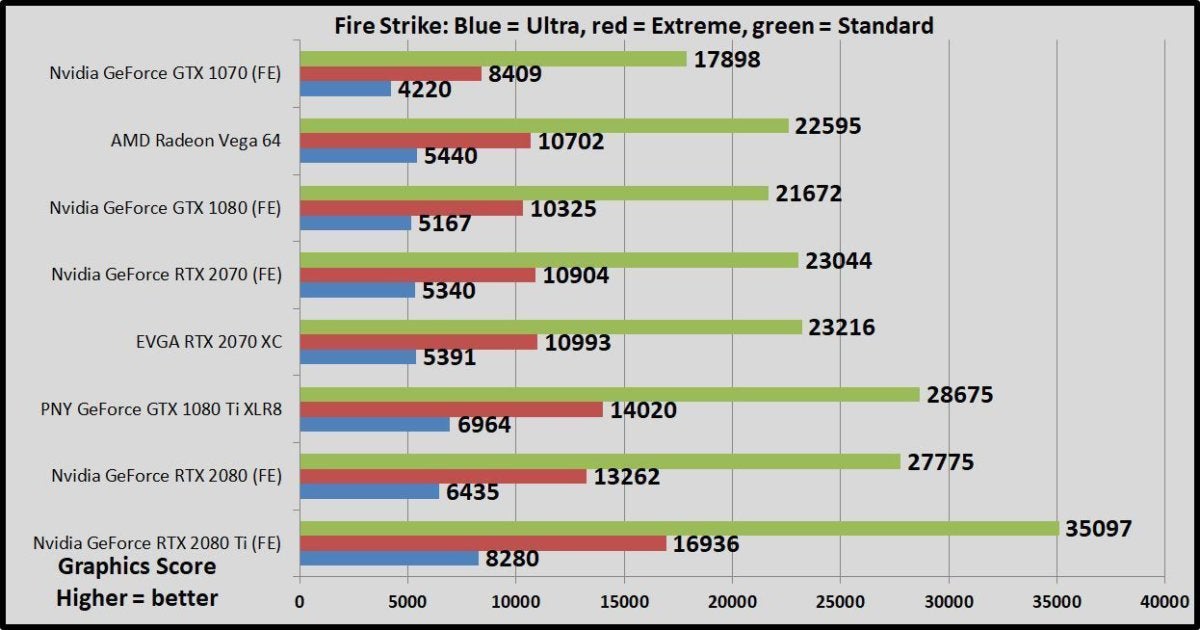
We too tested the GeForce RTX 2070 Founders Edition using 3DMark's highly respected Fire Strike synthetic benchmark. Evoke Strike runs at 1080p, Fire Expunge Extreme runs at 1440p, and Fire Impinge on Ultra runs at 4K resolution. All render the same scene, but with more intense graphical effects as you move skyward the descale, so that Extreme and Ultra flavors stress GPUs even more. We record the graphics sexual conquest to carry off disagreement from the CPU.
 Brad Chacos/IDG
 The RTX 2070 FE outpaces the GTX 1080, but interestingly, information technology International Relations and Security Network't quite as fast as the Radeon Vega 64 at 4K settlement (and only 4K resolution). With high-bandwidth memory board in towage, Vega was collective for high resolutions, and it shows here—though no of the $500 GPUs are really well-stacked for 4K.
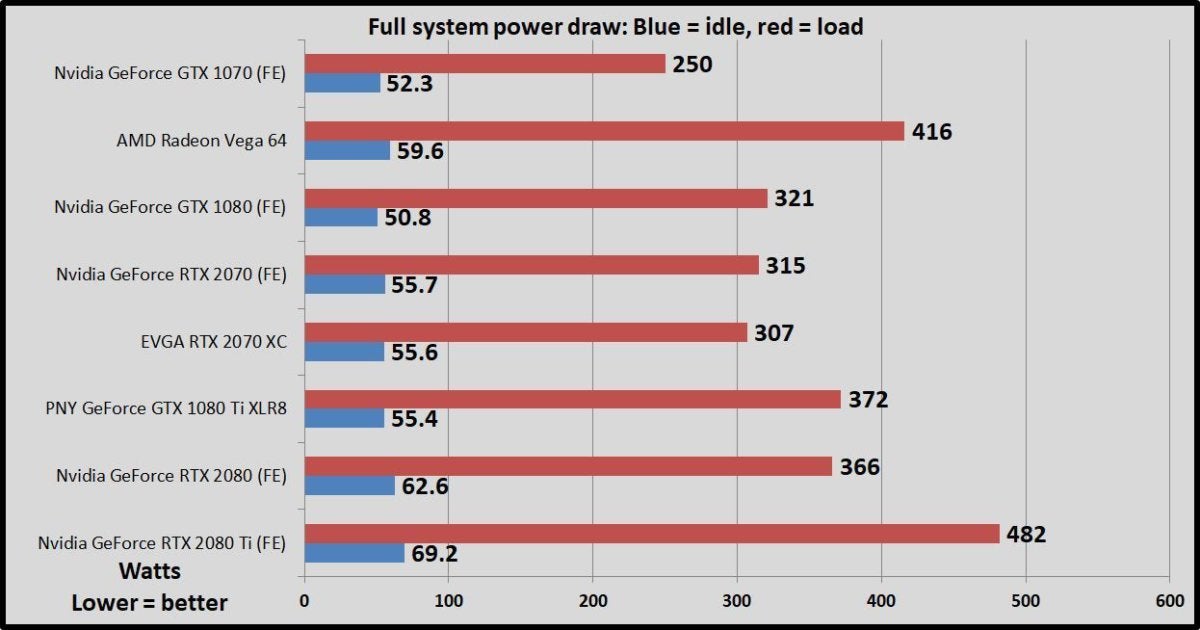
We quiz power draw by looping the F1 2018 benchmark after we've benchmarked everything else with a card, and noting the highest reading on our Watts Up Pro meter. The initial part of the race, where all competing cars are onscreen simultaneously, tends to be the almost needy portion.
 Brad Chacos/IDG
 Despite being firmly up of the GTX 1080 in carrying out, the RTX 2070 Founders Edition sucks down a teensy less tycoo. Yay efficiency! On the other end of the spectrum, the Radeon Lope de Vega 64 and extravagant GeForce RTX 2080 Ti Founders Edition each gobble an exorbitant amount of energy.
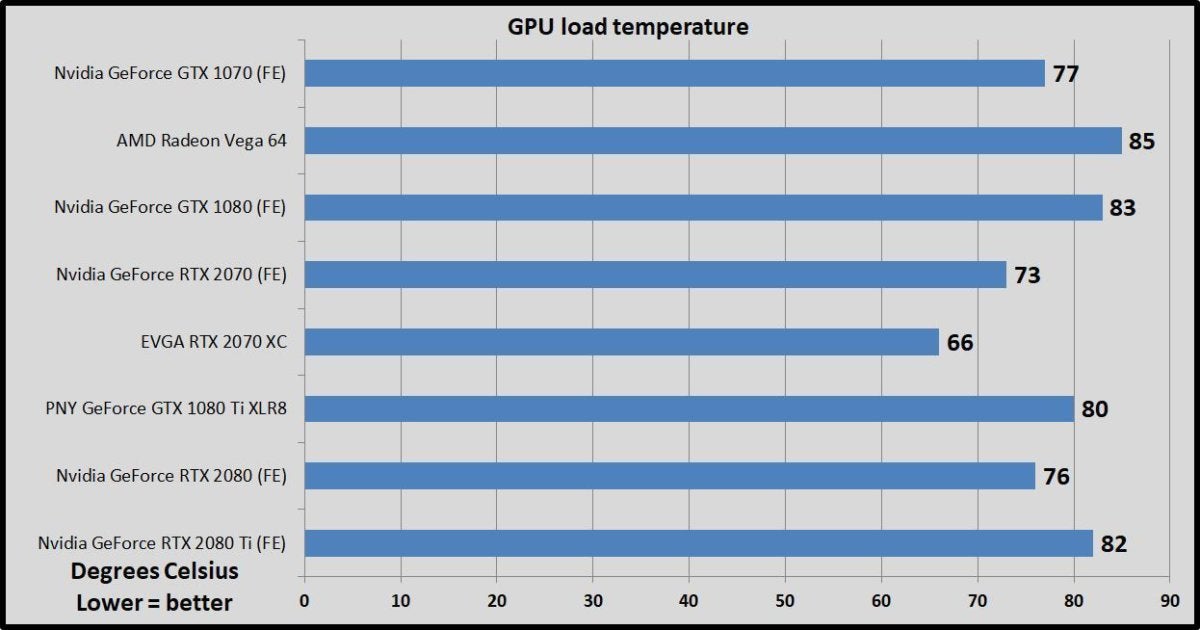
We run thermals by leaving HWInfo's sensor monitoring tool open during the F1 2018 5-lap ability force test, noting the highest maximum temperature at the cease.
 Brad Chacos/IDG
 Here's where you see just how the Founders Edition's move to dual-fans makes a difference. The RTX 2070 Iron is a full 10 degrees cooler than the GTX 1080 Iron, and lower temperatures mean fewer natural spring throttling. The RTX 1070 FE is untold quieter than the GTX 1080 FE too—a relative terminus that translates to "not immoderately loud." The Vega 64 reference edition, but then, is a hot, marvellous banshie. It's virulent just being in the same room arsenic the card when it's under load.
Next page: Overclocking, should you buy the RTX 2070 FE?
Nvidia GeForce RTX 2070 Founders Version overclocking
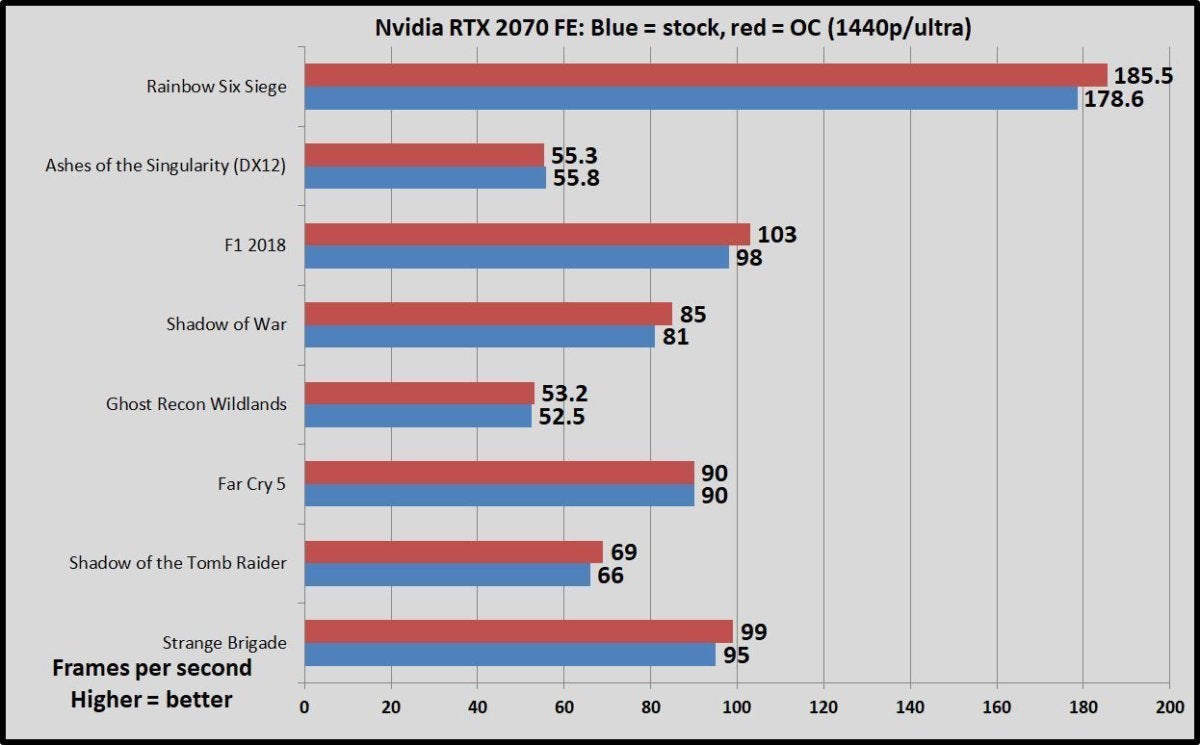
You don't arrive so much additive out of overclocking the Sir Thomas More stiff GeForce RTX 2080 and 2080 Ti, only we picked up just a bit more extra headroom with the RTX 2070 Iron. Victimisation the new one-button Nvidia Scanner overclocking tool in EVGA's slick Precision X1 software, we achieved an prosperous +160 score on the card—a honestly massive amount compared to what we've seen with other RTX GPUs. Applying the card-bespoke voltage and overclocking curve brought the imitative time from 1,410MHz to 1,505MHz, and the boost clock from 1,710MHz to 1,804MHz, as measured away GPU-Z.
Afterwards that, we maxed out the voltage, temperature, and power boundary sliders to unleash the card as much as possible. GeForce RTX-series cards are highly susceptible to power limits. Nvidia dialed back the available index restrain for the 2070 FE. Its more effectual RTX 20-serial cousins let you supercharge the power limit away almost 25 percent, which left Nvidia ironware partners care EVGA and Asus little elbow room to add more performance. The GeForce RTX 2070 Founders Edition limits you to 16 percent.
 Brad Chacos/IDG
 With all tweaks completed, we determined the card functioning right around the 2GHz roadblock in games, usually hovering between 1,995MHz and 2,010MHz depending on the workload. Hand-operated overclocking and memory overclocking could give pushed execution even further, but we'Ra happy with these near-effortless results of 4 percent to 5 percent lift up in many games. Some games showed no important clear, however.
The other Nvidia Scanner tool comes close to the maximum overclock for your GPU. Completely you have to do is dog a push, wait 20 proceedings for the process to run, and then drag few sliders to the right. Dig it.
Should you buy the Nvidia GeForce RTX 2070 Founders Edition?
It's much easier to recommend the GeForce RTX 2070 than the other RTX 20-series card game.
The GeForce RTX 2080 Ti is the fastest graphics circuit card ever discharged, and the first built for an era of 4K/144Hz monitors look-alike the Acer Predator X27, but it costs a staggering $1,200-plus when you can find it on Wall Street—a $500 addition over its predecessor. On the other hand, the $700 GeForce RTX 2080 (which sells for $800-plus actually) goes blow-for-blow with the older $700 or less GTX 1080 Ti in time-honored games, essentially asking you to pay a $100-plus superior for ray tracing and AI enhancements that aren't even available yet and aren't secure to explode in popularity. They'rhenium both interesting technologies that we promise are Hera to stay, but right at once, investing many for an RTX 2080 is a gamble on what the future will bring.
[ Further indication: GeForce RTX 2080 vs. GTX 1080 Atomic number 2: Which graphics card should you buy? ]
 Brad Chacos/IDG
 With GTX 1080 prices starting around $480 connected Newegg, and the GeForce RTX 2070 Founders Version costing $600 at Uncomparable Buy and GeForce.com, Nvidia's as wel asking you to pay more for the promise of ray tracing and Deep Scholarship Super Sampling. Just unequal the RTX 2080, the RTX 2070 FE outperforms its last-gen $500 equal, the GTX 1080, in traditional games as well. You can expect to see a double up-figure carrying out uplift in almost games, and finished 20 percent in games that love async compute capabilities, like Rainbow Six Siege. We didn't test HDR performance here, but the RTX 20-serial offers much inferior of a performance hit in those games, too, if you've bought an HDR video display.
The extra frames assume't change the core capabilities of these cards. The Radeon Vega 64, GeForce GTX 1080, and GeForce RTX 2070 are all excellent 1440p graphics cards, with the ability to tug 144Hz, 1080p monitors heavy. The quicker performance makes the RTX 2070 FE a reasonable entry-level 4K/60 option, too, especially if you've endowed in a 4K G-Synchronise proctor and don't mind dialing art settings from Ultra to High. That said, on a meta grade, it's leaves a rattling sour taste in my talk than Nvidia's $500 and $700 graphics card offerings deliver little to no performance improvement in orthodox games, roughly 2.5 years after the GTX 1080 launched.
This examination shows that every these years afterwards, the GTX 1070 is still a compelling (and much more affordable) 1440p/60 pick for $380. We run our tests with every art setting cranked to Ultra, and the GTX 1070 manages to surpass 60 FPS at 1440p nonetheless. In the few games where it behind't, dropping some graphics details down to High would push it over the hump.
 Brad Chacos/IDG
 We held off issuing review oodles to the RTX 2080 and 2080 Ti due to the slow predict of their core ray tracing and DLSS features. We'll issue a verdict for the GeForce RTX 2070 Atomic number 26, though. With GTX 1080s quieten being widely getable, I'd be hesitant to urge this higher-priced card supported on the promise of technologies hitherto to come alone. But with that pronounced bump in carrying out in traditional games baked in, I think out it's a no-brainer: Opt for a GeForce RTX 2070 over a GTX 1080 unless you see the latter connected a smoke hot sale. The RTX 2070 is faster in now's games, and you won't get left behind if ray tracing and DLSS get ahead traction. Win-come through, and slap-up for an extra $100.
Actually, IT doesn't eventide have to be an extra $100. While Nvidia's high-than-reference Founders Variant pricing serves As the cost floor for custom RTX 2080 and 2080 Cordyline terminalis graphics cards, information technology's rightfully a superior with this GPU. Nvidia says GeForce RTX 2070 partner cards wish go at $500, and we've already reviewed the $550 EVGA RTX 2070 XC, which—spoiler alert—runs even as fast A Nvidia's RTX 2070 FE, and much cooler.
Information technology's not quite a as luxuriant and sleek as Nvidia's board, though. The Founders Edition's all-metal, enclosed purpose is a pleasure to behold and to hold, and our review sample achieved a huge out-of-the-box overclock, though overclocking performance is never guaranteed. The Nvidia GeForce RTX 2070 Founders Edition's all-around elegance and vastly improved performance make it well Worth considering at $600, simply you can find comparably performing models for less.
Note: When you purchase something after clicking links in our articles, we may realize a small committee. Read our affiliate link policy for more details.

Source: https://www.pcworld.com/article/402768/nvidia-geforce-rtx-2070-founders-edition-review.html
Posted by: harbuckfingir.blogspot.com
0 Response to "Nvidia GeForce RTX 2070 Founders Edition review: Better tomorrow and today - harbuckfingir"
Post a Comment